From Reagan to Today: Democracy, Accountability, and American Leadership
Washington, D.C. – This week, the National Security, Department of State, and Related Programs (NSRP) Subcommittee, chaired by Rep. Mario Díaz-Balart (R-FL), hosted a hearing with the National Endowment for Democracy (NED) President and CEO, Damon Wilson.
The hearing provided Appropriators the opportunity to give serious attention to, and rigorous oversight of, the programs funded in the NSRP bill, as well as support the Trump Administration's America First foreign policy. The National Endowment for Democracy, founded by President Ronald Reagan, is a critical tool to advance U.S. foreign policy priorities around the world and support those fighting for freedom under authoritarian regimes in Iran, North Korea, and Cuba.
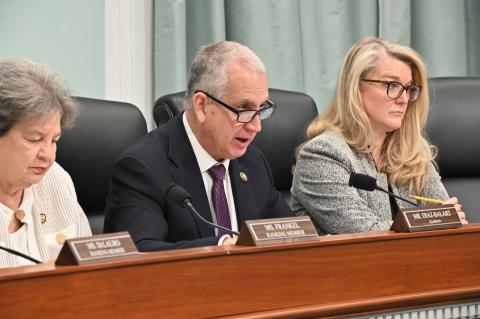
In his opening remarks, Subcommittee Chairman Mario Díaz-Balart said, "Foreign policy changes from one administration to the next. Yet the work of the NED remains consistent. As many of you know, I am a proud proponent of democracy and human rights promotion as a fundamental part of our foreign policy and national security. Toward that goal, the NED, and accountable democracy programs generally, are essential to countering adversaries, advancing American national security interests, and standing with those struggling for freedom... [NED] work[s] in some of the most dangerous and adversarial nations like Iran, like China. They have also been laying the groundwork for peace and stability in places like the South Caucases, which provides an opening for initiatives like the Trump Route for International Peace and Prosperity (TRIPP) connecting Armenia and Azerbaijan. Yes, NED has made mistakes. But, to NED's credit, they are extremely responsive and quick to recognize and rectify them. When they found a problematic issue with a grantee, they resolved it in a matter of days. Canceled it outright and got the money back. I wish every other federally-funded organization was that swift and responsive to Congress."
Read Chairman Díaz-Balart's full remarks here.
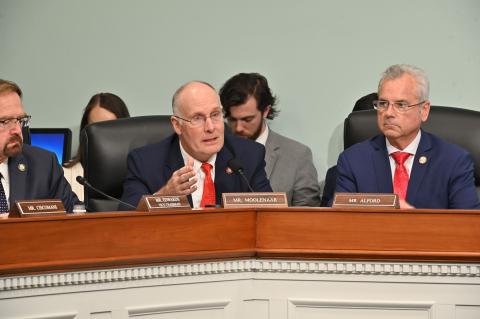
Rep. John Moolenaar (R-MI), who also chairs the House Select Committee on the Strategic Competition Between the United States and the Chinese Communist Party, focused on NED's work in China, where they are combating forced labor. Rep. Moolenaar said, "You've talked a bit about the Uyghur genocide and that designation, and the work NED did... A lot of American businesses are competing with companies that use slave labor, and also some of our supply chains are dependent on that. If you'd talk a bit about the surveillance, the national security laws that China and the CCP have put in place. You mentioned the police stations, and some of the vulnerabilities that Chinese nationals, even on our home shores, are affected by, if you could talk about NED's work in both of those areas."
Mr. Wilson responded that China is NED's largest program because of the large challenges to freedom and democracy within the country, as well as the scale of the CCP's influence on the world stage. NED works to document the Uyghur slave labor and oppression in-country and spreads that information to the rest of the world to help put pressure on the CCP and sway other freedom-loving nations from relying on the CCP.
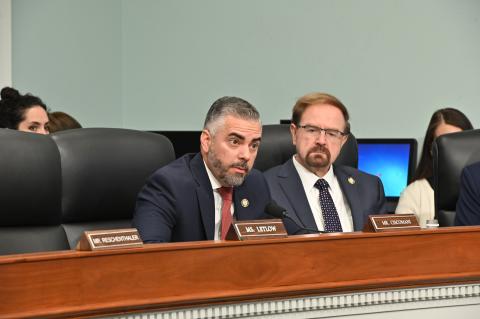
Rep. Juan Ciscomani (R-AZ) focused his questions on how NED defines success and how they measure that success. Rep. Ciscomani said, "A core criticism I've heard from my constituents on this is that they feel that funding soft power initiatives like NED has not resulted in a geopolitical landscape more favorable to the U.S. interest. With your questions and testimony here today, I hope we can help alleviate relevant criticisms about why continuing to fund NED has been a bipartisan priority and why it can align, if done properly, with newly affirmed and streamlined national security priorities by the Trump Administration, and how that's aligning itself to that. In light of this reality, how do you measure progress?"
Mr. Wilson explained that each grant is set up with benchmarks to achieve specific deliverables. In many cases, these grants will lead to concrete actions – like revealing an underground CCP police station in Manhattan.
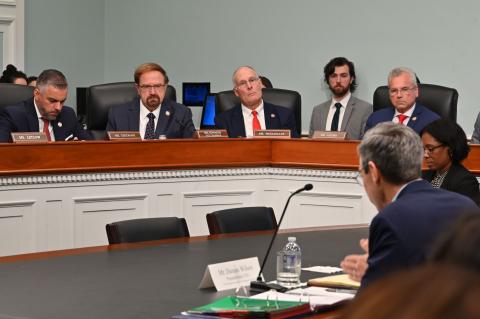
Rep. Chuck Edwards (R-NC) brought a report from the Heritage Foundation titled "The Undemocratic National Endowment for Democracy Needs Oversight and Reform," which outlines several recommendations to improve the work of NED. Rep. Edwards said, "[This report] says that NED's total revenue increased from about $180 million in Fiscal Year 2019 to over $300 million by Fiscal Year 2022, and it characterizes that growth as unjustified. Can you explain what specific geopolitical or congressional priorities drove that increase, such as support for Ukraine, countering other influences, or China-focused programming, and then also tell us whether those increases were tied to appropriated mandates from Congress rather than institutional expansion initiated by NED itself?"
Mr. Wilson acknowledged that the challenge to freedom has fundamentally changed around the world, and said we are currently in a two-decade democratic recession. Advanced technological tools used by authoritarian regimes, combined with growing alliances between those authoritarian regimes, require NED to scale up operations to maintain efficacy.
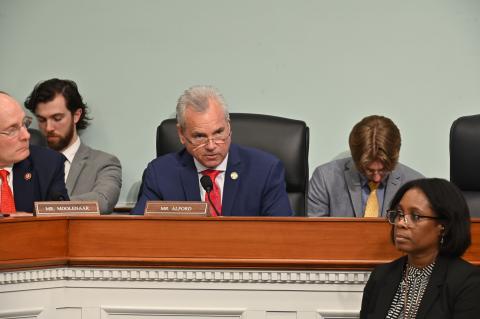
Rep. Mark Alford (R-MO) touted the historic legacy of NED while also cautioning against the funding of anti-American efforts. Rep. Alford said, "President Trump and Secretary Rubio have ushered in a new golden era of America First foreign policy. They've moved away from the old State Department mindset, one that too often focused on so-called global interests rather than American interests. American taxpayers should not send one single dollar to a program that does not support our clearly defined national interests... The National Endowment for Democracy was created in Congress in 1983 as an independent, nonprofit grantmaking institution intended to strengthen democratic institutions abroad. Its core mission has long been to support growth of democratic institutions, civil society, free markets, and the rule of law around the world. I believe that overall, NED supports this vision. Its work in Venezuela, Iran, China, and Russia have been critical to supporting American interests against these hostile nations. However, NED has not been perfect by any means... For NED, I choose not to throw the baby out with the bathwater, because I believe in the core mission of NED. The American people – my constituents – deserve to know [what you have to say about NED's funding of the Global Disinformation Index]."
Mr. Wilson was adamant that NED does not support censorship of Americans and does not fund anything with a domestic focus. He reiterated that as soon as NED discovered a grant partner was inappropriately using their funds to promote censorship of Americans, they rectified the situation and took full accountability.
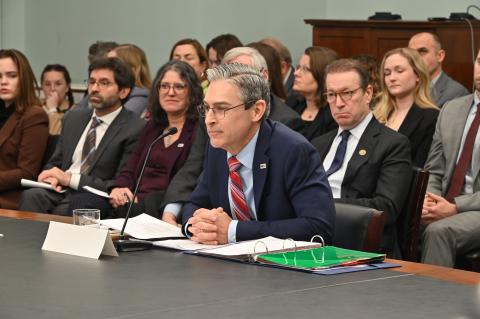
Appropriators continue to provide vigilant oversight over foreign aid to ensure that federal spending reflects American priorities at home and abroad. As the House Appropriations Committee moves into the FY27 funding process, the perspectives shared during this hearing will help shape funding decisions.
###
