Committee Approves FY27 Defense Appropriations Act
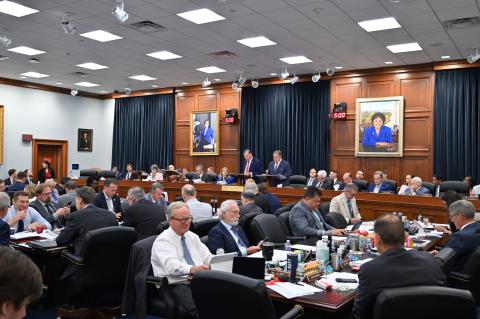
Washington, D.C. – Today, the House Appropriations Committee met to consider the Fiscal Year 2027 Defense Appropriations Act. The measure was approved by the Committee with a vote of 34 to 27.
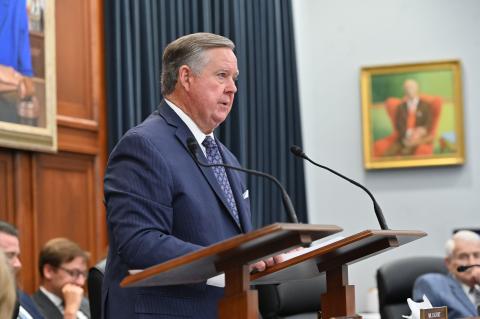
Defense Subcommittee Chairman Ken Calvert (R-CA) said, "The passage of our annual defense appropriations bill fulfills our commitment to keep America safe and ensure the U.S. military remains the strongest fighting force in the world. Recent conflicts have highlighted the pressing need to acquire and produce the munitions, weapons, and technology our troops require to meet the moment in both modern and future warfare. The increased funding provided in this bill aims to achieve that urgent goal in addition to building off the defense innovation programs I have prioritized as Chairman. The Defense Innovation Unit, APFIT, and Civil Reserve Manufacturing Network (CRMN) are prioritized in the FY27 bill to get our warfighters access to game-changing technologies, weapons, and the tools they need to win on the battlefield. I appreciate the leadership of Chairman Tom Cole and support from members of our Committee in advancing this bill."
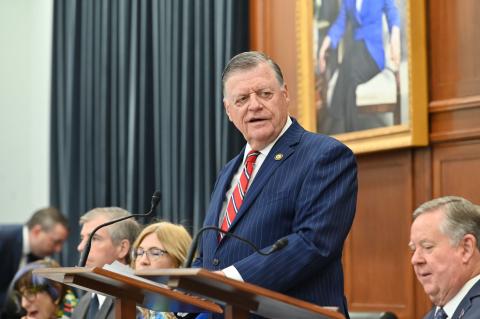
Chairman Tom Cole (R-OK) said, "Freedom is not self-sustaining, and deterrence is not self-executing. Both require stable resources, vigilance, and resolve. The FY27 Defense Appropriations bill recognizes that reality – and the serious inflection point the U.S. faces for the future safety and security of our nation. It does not shy away from the threats before us – it confronts them head-on, just as President Trump has called on us to do. This legislation makes historic investments to meet the moment and reverse years of underinvestment that have left us with aging platforms, shrinking capacity, and vulnerabilities that cannot be ignored. At a time when China is rapidly expanding its military capabilities and adversaries continue to sow instability, we cannot afford complacency. It is why every outlay is focused on delivering capability to the warfighter, modernizing our military, revitalizing the defense industrial base, and improving quality of life for those who serve. From pay raises for our troops and accelerating procurement to building new aircraft, ships, and submarines – Chairman Calvert’s legislation not only equips today's force – but also rebuilds the industrial capacity necessary to sustain tomorrow's. It is an investment in readiness, resilience, and America's long-term strategic advantage. As our twelfth bill approved out of the full committee, this legislation demonstrates that the House is doing its job – exercising its Article I responsibilities and providing for the common defense."
Subcommittee Chairman Calvert's opening remarks are available here.
Chairman Cole's opening remarks are available here.
Fiscal Year 2027 Defense Appropriations Act
The FY27 Defense Appropriations Act provides a total discretionary allocation of $1.072 trillion and enhances America’s strategic military advantage, strengthens support for service members and military families, optimizes the Department of Defense, disrupts transnational drug trafficking, and delivers on Trump Administration priorities.
Key Takeaways
Enhances America’s strategic military advantage by:
- Providing $836 million to procure, for the first time, new-entrant low-cost munition systems and providing multiyear procurement authority.
- Providing over $7.5 billion for hypersonic weapons and test infrastructure.
- Providing over $2.9 billion for Defense Production Act (DPA), Office of Strategic Capital (OSC), and Industrial Base Analysis and Sustainment (IBAS).
- Accelerating delivery of capability to the warfighter through over $1.7 billion for Defense Innovation Unit (DIU) and Accelerate the Procurement and Fielding of Innovative Technologies (APFIT).
- Transforming autonomous and counter-small, unmanned aircraft system initiatives with $1 billion for the Defense Autonomous Warfare Group (DAWG) and $1.4 billion for the Joint Interagency Task Force 401 (JIATF 401).
Strengthens support for service members and military families by:
- Supporting President Trump’s priority of a military pay raise of 7% for all military personnel ranked E-5 and below, 6% for E-6 to O-3, and 5% for O-4 and above.
- Providing an additional $15 million for the Military and Family Life Counseling Program, which provides counseling services to service members and their families to support operational readiness and resilience.
Optimizes the Department of Defense and improves transparency by:
- Supporting business modernization efforts, including $250 million to accelerate the transition to a modern, secure, and audit-ready financial management environment.
- Digitizing acquisition processes through $72.5 million for Acquisition Visibility.
- Protecting and preserving competition and readiness by mandating a Modular Open Systems Approach (MOSA).
- Modernizing requirements and resourcing by including $140.1 million for the Mission Engineering and Integration Activity and $92.7 million for Acquisition Integration and Interoperability.
Disrupts transnational drug trafficking by:
- Providing $1.2 billion for counter-drug programs.
- Increasing funding for the National Guard Counter-Drug Program.
- Providing $464.8 million for United States Southern Command, which supports enhanced detection and monitoring, theater-wide operations, improved command and control, and increased force protection to pursue drug cartels and terrorist networks.
- Transferring Mexico from United States Northern Command’s jurisdiction to United States Southern Command for better coordination and prioritization.
Delivers on Trump Administration priorities by:
- Advancing the President's Executive Order 14409, Promoting Advanced Artificial Intelligence Innovation and Security.
- Furthering the President's Executive Order 14369, Ensuring American Space Superiority.
- Supporting the President's Executive Order 14265, Modernizing Defense Acquisitions and Spurring Innovation in the Defense Industrial Base.
- Continuing to ensure that no funding supports diversity, equity, and inclusion (DEI) programs, Critical Race Theory, or abortion-related travel, consistent with Department of Defense policy.
- Prohibiting the use of funds to destroy surplus firearms or spent brass that are no longer of use to the United States military.
- Maintaining legacy provisions to prevent the closure or transfer of detainees from Naval Station Guantanamo Bay, Cuba.
A summary of the bill is available here.
During the markup, Committee Republicans also stood with the America First agenda and rejected Democrat amendments that would have:
- Stifled AI innovation and weakened America's competitive edge.
- Reduced resources for the National Guard.
- Inappropriately merged separate legislative processes.
- Limited the Trump Administration’s ability to administer grants.
- Restricted the Commander in Chief's ability to direct military forces.
- Curtailed the Secretary of Defense’s ability to travel.
- Eliminated funding for a next-generation missile defense shield protecting the U.S.
- Undermined the military’s ability to deter and respond to Iranian aggression.
- Mandated an unnecessary report.
- Created unnecessary hurdles for immigration enforcement and detention facilities.
Adopted Amendments
- Calvert #1 (Manager’s Amendment) – Makes technical, bipartisan changes to the bill and report.
- The amendment was adopted by voice vote.
- Calvert #2 (Republican En Bloc) – Strengthens military readiness, upholds pro-life principles, and prevents defense resources from being diverted to DEI, CRT, and other non-mission-focused programs.
- The amendment was adopted by a vote of 32 to 25.
Bill text, before adoption of amendments, is available here.
Bill report, before adoption of amendments, is available here.
###
