Committee Approves FY27 Financial Services and General Government Appropriations Act
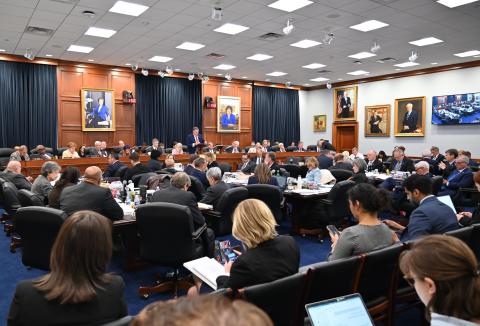
Washington, D.C. – Today, the House Appropriations Committee met to consider the Fiscal Year 2027 Financial Services and General Government Appropriations Act. The measure was approved by the Committee with a vote of 34 to 28.
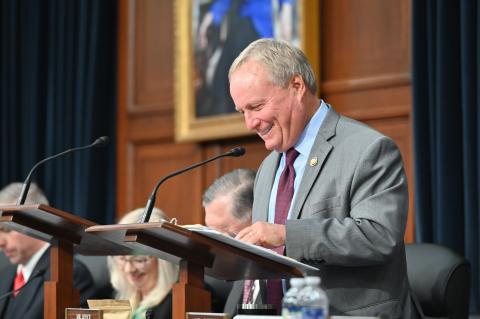
Financial Services and General Government Subcommittee Chairman Dave Joyce (R-OH) said, "The House Appropriations Committee is serious about maintaining regular order in government funding. This bill advancing out of committee highlights that commitment, and I look forward to it being brought to the House floor. We are cutting wasteful spending by leveraging new technologies and rooting out waste, fraud, abuse, and other improper payments across the government. This bill delivers for the American people, and I want to thank Chairman Cole and everyone involved for their work to advance this bill.”
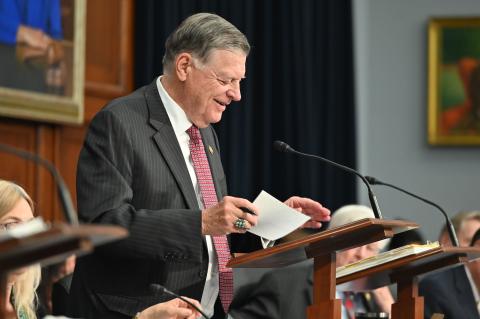
Chairman Tom Cole (R-OK) said, “With today’s full committee advancement of the FY27 Financial Services and General Government bill, we are continuing to build momentum and deliver on our commitment to responsible, results-driven governance. This legislation restores discipline to federal spending, eliminates waste, and ensures taxpayer dollars are focused where they matter most – supporting our economy, strengthening safeguards, and reinforcing the foundations of American success. The measure also upholds national security and community protection with investments to stop criminals and bad actors from exploiting our systems, trafficking drugs, attacking our cyber capabilities, and undermining public safety in the nation’s capital. Chairman Joyce’s work restores a government that operates with clarity, restraint, and purpose – and delivers real results for the American people. Line by line, appropriations are mission-focused and guided by purpose, not bureaucracy.”
Subcommittee Chairman Joyce's opening remarks are available here.
Chairman Cole's opening remarks are available here.
Fiscal Year 2027 Financial Services and General Government Appropriations Bill
The Financial Services and General Government (FSGG) Appropriations bill provides a total discretionary allocation of $25.3 billion, representing a savings of approximately $1 billion or 3.8% from the previous fiscal year.
The bill continues to deliver on President Trump’s America First reset by ending divisive, liberal policies and dismantling Biden-era Washington excess. It advances fiscal discipline, reasserts accountability and common sense, and refocuses the federal government on its core mission: serving the American people. The measure upholds the rights of U.S. citizens, strengthens national security, and harnesses technology to drive a government that works smarter, faster, and more efficiently for the nation.
Key Takeaways
Drives economic growth, supports U.S. financial systems, and invests in technology innovation by:
- Strengthening government-wide cybersecurity and information technology (IT) upgrades, modernizing infrastructure at agencies like the Treasury, the Executive Office of the President, and the Judiciary.
- Maintaining “Buy American” provisions that maximize the federal government’s use of services, goods, products, and materials produced and offered in the United States.
- Protecting consumer freedom in kitchen appliance, tool, and recreational vehicle products through prohibition of Biden-era regulations.
- Ensuring investments made in government and military retirement and savings plans are based on value, not climate activism criteria.
- Supporting entrepreneurship and small business development.
- Protecting investors, consumers, and main street with a strong, nimble, and technology-driven Securities and Exchange Commission.
Protects taxpayers from government overreach and reaffirms core rights by:
- Prohibiting the study, design, or development of a U. S. Central Bank Digital Currency – and bars any effort to eliminate paper currency as legal tender – due to concerns it could enable the federal government to track and monitor every transaction.
- Stopping non-citizen voting in state, local, and federal elections.
- Continuing to prohibit the IRS from targeting individuals for exercising their First Amendment rights.
- Supporting a fair judicial system.
- Protecting religious freedom and expression.
- Upholding President Trump’s work to restore the First Amendment by opposing efforts to prevent the censorship of lawful speech.
- Stopping the federal government from gathering and misusing personal ownership details about small businesses.
- Protecting small businesses from burdensome and costly credit reporting mandates under the Equal Credit Opportunity Act (ECOA).
Champions President Trump’s America First agenda and American values by:
- Codifying President Trump’s executive orders, including:
- EO 14240 titled, “Eliminating Waste and Saving Taxpayer Dollars by Consolidating Procurement.”
- EO 14274 titled, “Restoring Common Sense to Federal Office Space Management.”
- EO 14247 titled, “Modernizing Payments To and From America’s Bank Account.”
- EO 14249 titled, “Protecting America’s Bank Account from Waste, Fraud and Abuse.”
- EO 14208 titled, “Ending Procurement and Forced Use of Paper Straws."
- EO 14331 titled, “Guaranteeing Fair Banking for All Americans.”
- EO 14333 titled, “Declaring A Crime Emergency in the District of Columbia.”
- EO 14339 titled, “Additional Measures to Address Crime in the District of Columbia.”
- EO 14342 titled, “Taking Steps to End Cashless Bail to Protect Americans.”
- EO 14395 titled, “Establishing the Task Force to Eliminate Fraud Within the Executive Office of the President.”
- Blocking diversity, equity, and inclusion (DEI), critical race theory (CRT), and other divisive programs.
- Defunding the disastrous Biden-era climate rule and other green new scam-style mandates – including environment, social, and governance (ESG) initiatives.
- Restricting the procurement of electric vehicles for federal government use.
- Maintaining critical pro-life riders, including prohibitions on taxpayer funds for abortions.
- Prohibiting the Federal Employees Health Benefit Program from covering puberty blockers, hormone therapy, or surgical procedures for gender-affirming care.
- Codifying the Regulations in Need of Scrutiny (REINS) Act, which curbs unelected bureaucrats from having unfettered regulatory power.
- Allowing only the American flag and other official government flags to be flown over federal facilities.
Bolsters U.S. national security and border protections by:
- Fully funding the Committee on Foreign Investment in the United States to ensure it has the tools to adequately scrutinize foreign investment by countries like China.
- Guaranteeing that no federal funds support laboratories owned by the Chinese Communist Party, including the Wuhan Institute of Virology, or other adversaries.
- Maintaining funding for Treasury’s Office of Terrorism and Financial Intelligence to strengthen efforts to prevent and deter terrorists, criminals, and other bad actors from using the financial system.
- Equipping Treasury and other agencies with tools to bolster cybersecurity and stop foreign adversaries and criminals from hacking our nation’s critical infrastructure.
- Protecting Americans from deadly drugs like fentanyl by investing in the High Intensity Drug Trafficking Area (HIDTA) program to strengthen interdiction efforts and stop narcotics from entering our borders and communities.
Restores fiscal sanity and protects taxpayer dollars by:
- Cutting nearly 3.8% from the FY26 enacted bill, saving taxpayers a billion dollars.
- Shrinking the size of the federal workforce to pre-COVID/Biden levels.
- Continuing important oversight of remaining COVID-era programs and funding streams to stop waste, fraud, and abuse of taxpayer dollars.
- Taking steps to identify underutilized federal office spaces to lower costs and cut wasteful Washington spending.
- Codifying executive orders to help crack down on waste, fraud, abuse, and improper payments in the federal government.
Enforces constitutional oversight of the District of Columbia by:
- Maintaining pro-life safeguards on the use of government funds.
- Retaining the conscience clause on any D.C. contraceptive requirement.
- Banning D.C.’s harmful and addiction-enabling needle exchange program.
- Repealing D.C.’s assisted suicide legalization law.
- Recognizing valid concealed carry licenses from other states in the District of Columbia and the Washington Metropolitan Area.
- Prioritizing charter schools' funding and merit-based tuition assistance.
- Codifying the President’s EO to crack down on crime in D.C. and ensure that the District remains a safe and beautiful attraction for residents, tourists, and workers.
A summary of the bill is available here.
During the markup, Committee Republicans rejected amendments offered by the Democrats that would have:
- Expanded government bureaucracy and increased spending.
- Initiated government raises at the expense of taxpayers.
- Prevented the agencies from managing their own workforces.
- Supercharged the IRS with a $1 billion injection to expand audits and enforcement on everyday Americans
- Sought to limit immigration enforcement efforts.
- Codified Obama-era guidance.
- Hampered efforts to dispose of government assets, driving up costs for taxpayers.
- Held OMB funding hostage and blatantly undermined executive branch independence.
- Targeted presidential authority.
- Allowed federal government employment of illegal immigrants.
- Repealed multiple pro-life riders and allowed taxpayer dollars to be used for abortion.
- Duplicated a government study, wasting resources.
- Blocked efforts to rescind wasteful and unnecessary spending.
- Allowed the Internal Revenue Service (IRS) to develop a free, public electronic return-filing service option without approval or oversight from Congress.
- Pushed pro-union policies on government workers.
Adopted Amendments
- Joyce #1 (Manager’s Amendment) – Makes technical, bipartisan changes to the bill and report.
- The amendment was adopted by voice vote.
- Joyce #2 (En Bloc) – Furthers Republican policies, including – but not limited to – strengthening public charter schools, prohibiting the FCC from reconfiguring or repurposing the lower 900 MgHZ band, supporting SBA microloan TA awards, and directing GSA to submit more timely prospectuses.
- The amendment was adopted by voice vote.
- Bice #1 – Implements a study on small business loans to ensure American citizens have reliable access to capital.
- The amendment was adopted by a vote of 34 to 28.
- Reschenthaler #1 – Urges all federal construction, repair, or improvement projects to use steel produced in the United States.
- The amendment was adopted by a vote of 31 to 27.
- Harris #2 – Supports small banks by raising certain asset thresholds to ease regulatory burdens.
- The amendment was adopted by voice vote.
Bill text, before adoption of amendments, is available here.
Bill report, before adoption of amendments, is available here.
###
